One of the most neglected facets of diabetes management in India is diabetic foot care. Due to a lack of knowledge about their health or education, the majority of patients are unaware of their diabetes condition. The most common reason for diabetic foot and the later development of foot lesions is the wearing of improper footwear or no footwear at all.
Non-qualified individuals' engagement and self-medication with natural treatments worsen the illness. The issue is made worse by a delay in receiving medical attention.
Diabetes patients are frequently so pre-occupied with managing other medical conditions, that their feet may be the last thing on their minds.
Our Aims of Diabetic Foot Care
To salvage the foot and toes as far as possible.
Take care of circulation issues and restore circulation if possible.
To preserve function of the foot.
To heal the ulcer & to remain ulcer free for long term.
Prevent skin lesions, fungal infections and nail problems.
Reduce the risk of injury, infection and complications.
To consider financial burden for patient & cost effective care.
How Can Diabetes Affect Your Foot?
Diabetes may result in diabetic neuropathy, or nerve damage, which can initially make you feel tingling, pricking or burning sensation in your foot. As it progresses, callus develops, which may go unnoticed, which can result in ulcer. Infection can spread to ulcer easily.
Diabetes might also result in reduced blood circulation to your feet. It may be difficult for an infection or sore to heal if there is insufficient blood flow, due to which infection spread rapidly. Progression of infection without medical intervention may result in gangrene.
Individuals with uncontrolled diabetes are more likely to develop peripheral artery disease and neuropathy, as well as infections and a lowered immunity to fight these infections. As a result, diabetics are more likely to experience regular and frequently serious foot issues as well as a relatively high risk of infection & gangrene.
When Should a Diabetic Patient See a Surgeon?
The following symptoms of diabetes mellitus may help you recognize that your foot requires attention:
Reduced sensation in foot.
A sensation of walking on a mattress made of cotton.
Unable to feel pain, even after getting injured or having an ulcer.
Leg cramps at night
Feeling of pins and needle in legs
Development of thicker skin patches on the sole
Swelling or discharge from unnoticed wound or ulcer.
See Diabetic Foot Doctor Immediately
SEE DIABETIC FOOT DOCTOR IMMEDIATELY, IF YOU SEE:
Ulcer in foot, which does not heal in couple of weeks.
Redness or warmth in any part of foot
Nail or toe discoloration that occurs suddenly.
Increased temperature of one foot in comparison to the other foot.
A fever associated with foot pain.
Why Should I Be Concerned If I Am Not In Pain?
Nerve injury can cause numbness, tingling, or pain in some people, but not in others. Damage to your nerves might also make it harder for you to feel cold, hot, or discomfort.
Life without pain may sound pleasant, but it has a high price. Your body uses pain to alert you to a problem so you can take care of yourself. You might not detect a cut, blister, sore, or other ailment if your feet are numb or senseless. If small issues are not addressed right away, they may grow into big ones.
Callosity and Deformity
Motor neuropathy causes muscle weakness, resulting in abnormal foot biomechanics and deformities such as hammer toes, claw toes, as well as the presence of neuropathy facilitating callus formation.
A callus is a thickening of the skin and hardening of any part of sole feet caused by repeated friction and pressure. Skin thickening is common on the soles of the feet, particularly in weight bearing areas caused by repeated weight bearing friction/pressure on the same area, as well as due to unbalanced weight distribution, the use of inappropriate footwear, or skin disorders.
If a callus is manipulated (scrapped or cut) without aseptic precautions, it may get infected. Callosity and deformities should be corrected before ulcer develops.
Non Healthy Ulcers (DFU)
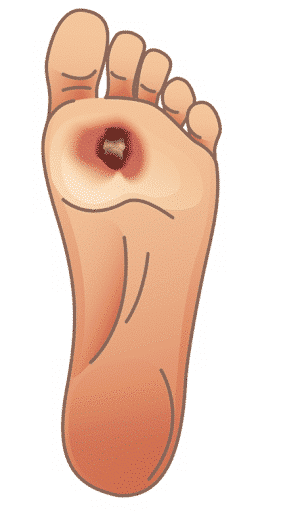
The callus eventually grows thicker and larger. Over a time it act like a hard stone, on the underlying skin which eventually breakdown and leading to ulceration.
Once an ulcer develops, persistent pressure while walking does not allow the ulcer to heal. This non-healing ulcer is resistant to all forms of conservative therapy.
Appropriate offloading management is the only treatment that can provide consistent, predictable, recurrence-free recovery.
What is Charcot's Foot?
A Charcot foot is a problem of Bones and joint of foot & Ankle. Degenerative changes in Bones of foot & Ankle with loss of proprioception of joint due to Neuropathy, Triggers hair like cracks in Bones of foot & Ankle even during normal physical activity which usually not seen on X-Ray but should be Suspected in hot swollen foot. If diagnosed early & Treated Correctly, deformity & Major problems can be prevented.
Why Does My Foot Need To Be Examined & See My Doctor?
Examining your foot provides information on:
Your foot's current condition.
Your foot's prognosis and future; and
The likely course of treatment for your foot.
Follow-up preparation
Footwear and Preventive Podiatry
Preventive Podiatry is the preferred method of treating pre ulcer foot (callosity stage). Footwear that prevents injury, help in distribution of body weight at normal weight bearing area is essential.
Why Should You Meet Dr Mayank Raval for Diabetic Foot?
People with diabetes mellitus may develop lesions on their feet called diabetic foot ulcers. Approximately 15% of diabetics get foot ulceration. The sooner foot ulcers are properly diagnosed and treated, the more likely they are to be cured. The main goal of treating a foot ulcer is to prevent recurrence.
Dr. Mayank Raval treats diabetic foot ulcers from the simplest to the most difficult wounds needing restoration. He makes use of his knowledge for complete recovery without recurrence. He has assisted numerous patients in avoiding wound complications such infections that could result in limb loss.
Frequently Asked Questions
What are three things you should never do to a diabetic person's feet?
Avoid use heating pads. They can be comforting and calming but heating pads, electric blankets, hot water bottles, and even excessively hot baths can be hazardous for someone with diabetes.
Avoid eliminating corns by yourself.
Avoid walking bare foot.
How long does it take a diabetic foot to heal?
The size and location of the wound, pressure from walking or standing, swelling, blood circulation, blood glucose levels, and wound care, along with medication provided are all variables that affect how quickly a wound will heal. Healing can take a few weeks or several months.
How should a diabetic foot wound be cleaned?
Use saline water to clean the wound. After cleaning, apply antibiotic ointment. To stop bleeding and protect the wound, bandage it. See your doctor earliest possible.